Executive Functioning and implicated brain recruitment distinctions in youth antisocial phenotypes
Last updated on
Nov 1, 2023
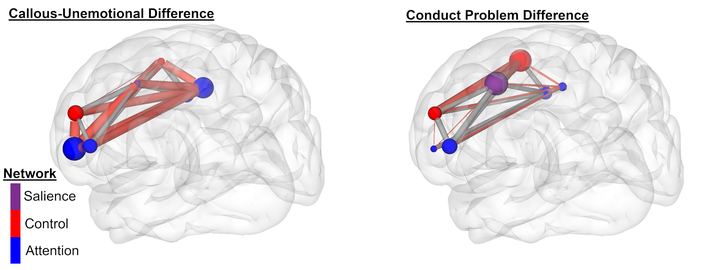
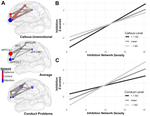
Executive functioning is a ubiquitous and transdiagnostic factor across mental health symptoms - and implications in youth antisocial phenotypes are mixed. This project seeks to determine distinctions in executive functions betwen distinct (yet related) antisocial phenotypes as well as their contributions to charactistic impairments vis implicated brain properties.

Theory of Mind
Executive Function
Cognitive Control
Callous-Unemotional Traits
Experimental Design
fMRI
Functional Connectivity
Drew E. Winters, PhD.
Assistant Professor of Psychiatry
My research interests include mental and social health, as well as their associated neural processes across the lifespan. In this vein, I am interested in applying quantitative methods to identify replicable neural mechanisms that may improve testing and development of interventions for youth with callous-unemotional traits.
Related
- Cognitive control and affective theory of mind in early adolescents with callous-unemotional traits
- Resting-state connectivity underlying cognitive control’s association with perspective taking in callous-unemotional traits
- Brain Communication for Executive and Social Function in Adolescents with Callous-Unemotional Traits
- Affective theory of mind impairments underlying callous-unemotional traits and the role of cognitive control
- Functional brain properties in adolescents with callous-unemotional traits and potential mechanisms
Publications
This project examined functional brain features of aggression across the literature
Jules Dugre,
Christian Hopfer,
Drew E. Winters
Introduction- Youth antisocial behavior strongly associates with conduct problems (CP) and callous-unemotional (CU) traits. While CP …
Drew E. Winters,
Juliet Spitz,
Kristen Raymond,
Crystal Natvig,
Rebecca Waller,
Susan K. Mikulich-Gilbertson,
Joseph T. Sakai
Although callous-unemotional (CU) traits are linked with antisocial behavior, affected youth still engage in some prosocial behaviors. …
Drew E. Winters,
Joseph T. Sakai
Introduction- Youth antisocial behavior strongly associates with conduct problems (CP) and callous-unemotional (CU) traits. While CP …
Drew E. Winters,
Juliet Spitz,
Kristen Raymond,
Crystal Natvig,
Rebecca Waller,
Susan K. Mikulich-Gilbertson,
Joseph P. Schacht,
Joseph T. Sakai
Introduction- Youth antisocial behavior strongly associates with conduct problems (CP) and callous-unemotional (CU) traits. While CP …
Drew E. Winters,
Joseph P. Schacht
This project employed advanced statistical approaches to redress issues in the field examining antisocial phenotypes in relation to executive functions. We found some support for existing literature while extending it to demonstrate distinct brain and executive function associations in the presence of Callout-Unemotional traits and Conduct Problems.
Drew E. Winters,
Jules Dugre,
R. Mckell Carter,
Joseph T. Sakai